

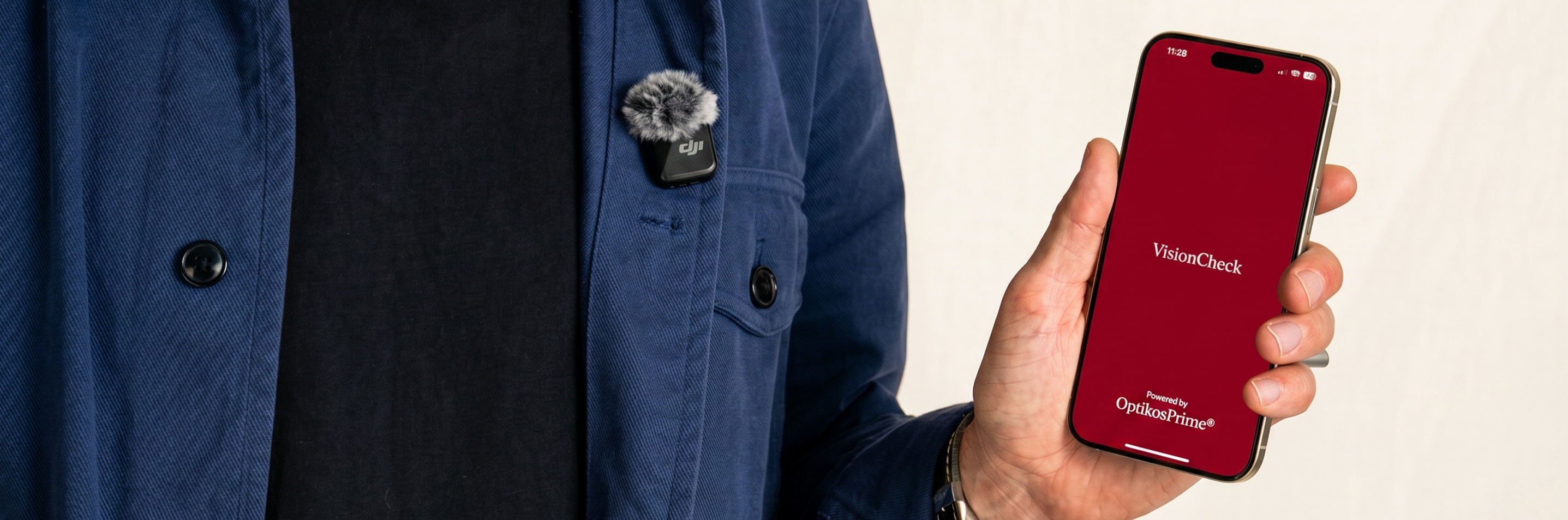

The Smartphone Is Becoming the World’s Most Important Medical Device
AI is transforming smartphones from communication devices into powerful healthcare tools. Vision care is just the beginning.
For decades, healthcare innovation has largely focused on building better hospitals, more sophisticated equipment, and increasingly specialised medical devices. These advances have transformed patient care, but they have also made healthcare more dependent on expensive infrastructure, trained professionals, and physical access to clinics.
Artificial intelligence is beginning to change that equation
Instead of asking how we can build better hardware, we can now ask a different question: what if the hardware people already carry every day is enough? Around the world, billions of people own a smartphone. As cameras, sensors, and AI continue to improve, smartphones are evolving from communication devices into powerful healthcare platforms.
At OptikosPrime, we believe this shift represents one of the most important changes in modern medicine.
Watch: Why We Believe the Future of Vision Care Is Software
In this short video, our Co-Founder, Ståle Fredlund Husby, explain why smartphones and AI are fundamentally changing how vision assessment can be delivered and why we believe this technology can expand access to eye care for billions of people.
Healthcare doesn’t just have a technology problem. It has an access problem
Medical knowledge has never been more advanced, yet millions of people still struggle to access even the most basic healthcare services. The challenge is often not that treatments don’t exist, but that diagnosis depends on expensive equipment located far from the people who need it.
Vision care illustrates this perfectly. More than 2.2 billion people worldwide live with vision impairment, and at least one billion cases remain preventable or unaddressed. In many cases, the solution is straightforward: a simple pair of glasses. Yet that solution can only be delivered once someone has been assessed, and traditional vision assessment still relies on clinics, specialised hardware, and trained personnel.
This creates a bottleneck that limits both access and scale.
Software is beginning to replace hardware
Throughout history, technology has repeatedly shown that software eventually replaces dedicated hardware. Cameras became smartphone apps. GPS devices disappeared into navigation software. Music players, calculators, scanners, flashlights, and even desktop computers have gradually been absorbed into a single device that fits in our pockets.
Healthcare is now entering a similar transition
Rather than relying exclusively on specialised medical equipment, advances in computer vision and artificial intelligence allow increasingly complex diagnostic tasks to be performed using devices people already own. Instead of distributing millions of new machines, we can distribute software.
That dramatically changes the economics of healthcare.
Why we’re building OptikosPrime
Five years ago, we asked ourselves what seemed like an impossible question: Could a smartphone determine what glasses someone needs?
Today, after years of research in computer vision, optics, and machine learning, we’re demonstrating that the answer is yes.
Our Argus platform estimates refractive error from smartphone images, moving one of eye care’s most hardware- and personnel-intensive processes into software. This isn’t about replacing optometrists or ophthalmologists. It’s about enabling billions more people to enter the eye care system by making vision assessment dramatically more accessible.
For healthcare providers, it means reaching more patients. For NGOs, it means screening more people with fewer resources. For consumers, it means easier access to vision care. And for society, it means fewer people living with avoidable vision impairment simply because they couldn’t access an eye examination.
A much bigger shift
We believe vision care is only the beginning.
As AI continues to mature, more healthcare services will move from specialised hardware to software running on everyday devices. The winners won’t simply build better medical equipment; they’ll rethink which equipment is needed at all.
Help Shape the Future of Healthcare
We believe the next generation of healthcare will be defined by software that makes high-quality care more accessible, affordable, and scalable. If you’re an investor, healthcare provider, researcher, NGO, or technology partner who shares that vision, we’d love to explore how we can build it together.
Get in touch to discuss partnerships, pilots, research, or investment opportunities.
